Two terms keep showing up in the same conversations: AI SEO and GEO (Generative Engine Optimisation). Both claim to make your business visible when people increasingly get answers from AI rather than clicking through search results. But they point at different work, and knowing the difference saves you from buying the wrong thing.
In New Zealand, some agencies use “AI SEO” and others use “GEO” for services that overlap quite a bit in practice. This article puts them next to each other in plain English. By the end you will know which term points at which type of work, and what to ask a supplier before signing anything.
Contents of this Article
What “AI SEO” usually means
AI SEO is traditional search engine optimisation with AI bolted on. The tools change, the target stays the same: Google and other search engines.
In practice, AI SEO means using AI to generate keyword clusters, write content briefs, automate schema markup, and speed up technical audits. The measurement stays familiar: rankings, organic traffic, click-through rate. Agencies offering AI SEO in New Zealand typically focus on getting your pages into Google search results and, more recently, into Google AI Overviews (the AI-generated summaries that appear above regular results).
The term works well for businesses already doing SEO who want the process to run faster. Where it gets misleading is the implication that AI is only a productivity tool for existing SEO. It skips over the fact that a whole new set of engines now generates answers independently of Google.
What GEO actually covers
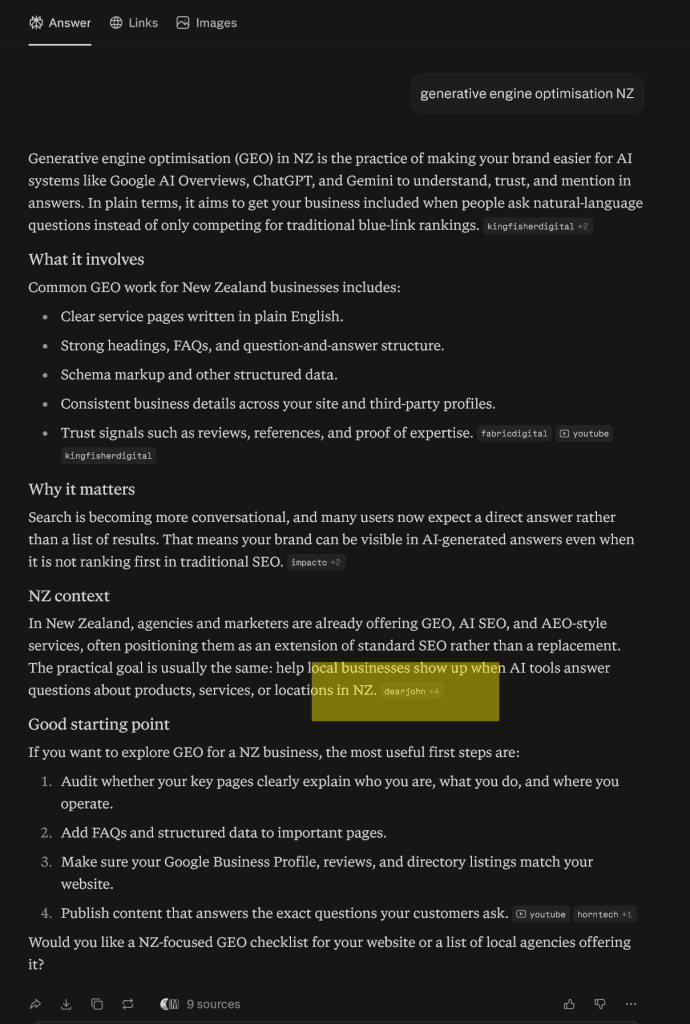
GEO stands for Generative Engine Optimisation. The target is different: instead of ranking on a search results page, the goal is being cited in AI-generated answers.
Those answers come from tools like Perplexity, ChatGPT search, Claude, Gemini, and Google AI Overviews. Each of these systems reads sources, decides which ones to trust, and either names them or draws from them without attribution. GEO is the work of making your business one of those trusted sources.
The signals GEO relies on are different from backlinks and keyword density. Entity consistency matters: does your business show up the same way across Wikidata, Google Business Profile, schema markup, and your own site? Content structure matters: can an LLM extract a clean, quotable answer from your page? And llms.txt, a machine-readable file that tells AI crawlers what your site is about, is becoming part of the toolkit.
GEO does not replace SEO. It sits alongside it. Some of the work overlaps (schema, content quality, site structure), but the measurement is fundamentally different: you are tracking whether AI systems cite you, not whether Google ranks you.
More on how Dear John NZ approaches GEO
The overlap and the real difference
Most of the confusion comes from the overlap. Both AI SEO and GEO care about structured data, content quality, and technical site health. The split is in what they optimise for and how they measure success.
| Dimension | Traditional SEO | AI SEO | GEO |
|---|---|---|---|
| Primary target | Google search results | Google search results + AI Overview | AI-generated answers (Perplexity, ChatGPT, Claude, Gemini) |
| Success metric | Rankings, organic traffic | Ranking + presencein AI overviews | Being cited or named in generated answers |
| Core signals | Backlinks, keywords, site speed | Backlinks, keywords, E-E-A-T | Entity signals, schema, llms.txt, external source mentions |
| Typical NZ usage | Widely used | SEO agencies adding AI tools | Specialists, LLM-focused |
A practical way to tell which one a supplier is actually doing: listen to what they measure. If the conversation centres on rankings and clicks, that is AI SEO. If it centres on citations, entities, and which sources AI engines read, that is GEO.
Both are legitimate. Neither is a scam. They solve different parts of the same problem: making your business findable when people ask questions online.
Which one does your NZ small business actually need?
That depends on where your customers find you today.
If most of your leads come through Google search and your competitors are visible there, AI SEO work is probably where the return sits. Your rankings, your content pipeline, your technical health, all sped up with better tooling.
If customers have started saying things like “I saw your name in ChatGPT” or “Perplexity recommended you”, GEO is already working for you. The task then is to strengthen it: tighten your entity signals, structure your content for citation, make sure your llms.txt is current.
If you are starting fresh and nobody knows your business yet, whether you are in Auckland, Wellington, or anywhere else in New Zealand, laying the entity foundation (Wikidata entry, schema markup, llms.txt, consistent business name across platforms) is relatively low-cost and covers both sides. You build for Google and for AI engines at the same time.
One NZ-specific observation: “AI SEO Wellington” and “AI SEO New Zealand” are queries people search, but very few local suppliers answer them with a clear explanation. Most answer with a service page. If you are a small business trying to understand the landscape before spending money, explanation is more useful than a sales pitch.
Questions worth asking a supplier
- Which engines do you optimise for: Google only, or also Perplexity, ChatGPT, Claude?
- Do you work with schema markup and llms.txt, or only on-page content and links?
- How do you measure success: rankings, traffic, or citations in AI answers?
- Can you show me an example where a client is cited in an AI-generated answer?
- Do you update entity sources (Wikidata, Google Knowledge Panel) as part of the work?
The answers will tell you more about what you are actually buying than any label on a service page.
Frequently asked questions
Is AI SEO the same as GEO?
Not quite. AI SEO usually means using AI tools to do search engine optimisation faster, with a focus on Google. GEO is specifically about being visible and cited in AI-generated answers from engines like Perplexity, ChatGPT, and Claude. They overlap on things like schema and content quality, but the targets and measurements differ.
Will GEO replace traditional SEO?
No. Google still sends the majority of web traffic in New Zealand. GEO adds a layer on top of SEO for the growing number of people who get answers from AI instead of clicking search results. Both matter; the balance shifts depending on your industry and audience.
Do I need both AI SEO and GEO?
It depends on your business. If all your customers find you via Google, AI SEO covers the ground. If AI-generated answers are becoming a source of leads or visibility in your sector, adding GEO work makes sense. For many NZ small businesses, starting with a solid entity foundation serves both.
How long does GEO take to show results?
Longer than you would like. Entity signals, schema, and content structure take weeks to months to be picked up and trusted by AI systems. Some changes (like adding llms.txt or fixing schema) can show effects within weeks. Building external citations and consistent entity presence is a longer game.
Is GEO more expensive than SEO?
Not necessarily. Some GEO work (schema markup, llms.txt, Wikidata entries) is a one-off setup cost. Ongoing GEO work (content structured for citation, entity monitoring, external citation building) runs at similar rates to ongoing SEO. The difference is in what you are paying someone to optimise for, not in the hourly rate.
Where does Dear John NZ fit: AI SEO or GEO?
Dear John NZ works across both, with a particular focus on GEO for NZ small business. The approach starts with entity foundations (schema, llms.txt, Wikidata, Google Business Profile) and builds outward with content structured for AI citation. Based in Paraparaumu on the Kapiti Coast, Wellington region
Where the terms are heading
These labels will merge. Give it two years and nobody in New Zealand will talk about “AI SEO” and “GEO” as separate disciplines. It will just be AI visibility: are people finding your business when they ask a question, regardless of which system generates the answer?
What matters right now is whether the person doing this work for you understands that AI answers are their own layer, with their own signals, and their own way of deciding who gets mentioned.
Dear John NZ works with NZ small business across the Wellington region on GEO and AI SEO together. See Generative Engine Optimisation NZ | Dear John