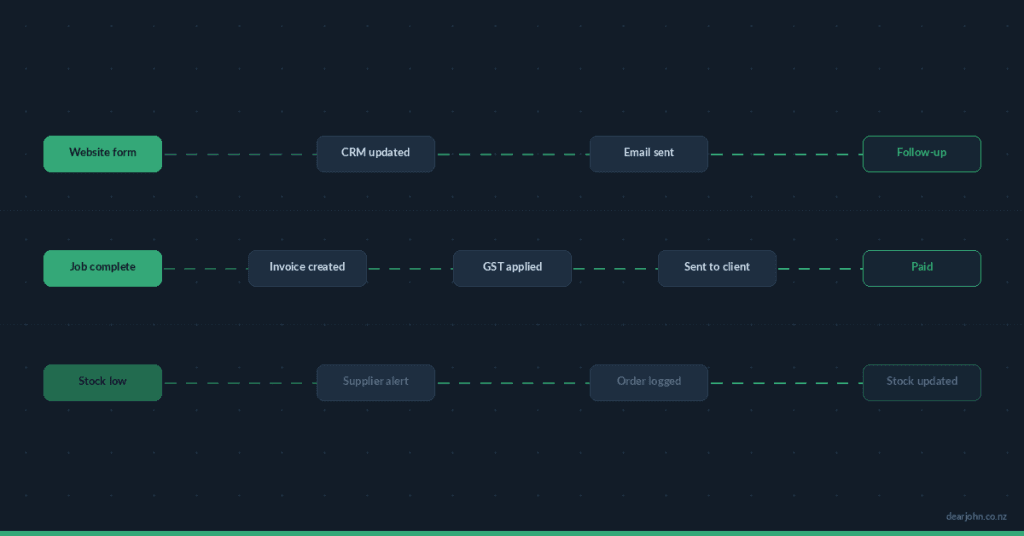
Business automation for New Zealand small business usually means one thing: work that keeps running without someone pushing every button. Dear John NZ builds that. Connections between Xero, Calendly, a CRM and email that keep working once they are set up.
Most small businesses don’t have an automation problem. They have a prioritisation problem.
They automate what’s visible — what someone mentioned at a networking event, what the software vendor demoed, what looked impressive in a case study. Not necessarily what would make the biggest difference to how the business actually runs.
That’s where things go sideways. Time and money spent on a process that didn’t need fixing, while the stuff that’s genuinely grinding people down keeps grinding.
Business process automation in New Zealand has moved well past the “should we bother?” stage. As of 2024, approximately 66% of businesses have automated at least one process, and with good reason: McKinsey estimates that current technologies can automate work activities absorbing up to 70% of employees’ time.
The question now is: which process first, and how do we choose without guessing? This is a practical framework for exactly that.
Contents of this article
What process automation does for a NZ small business
Process automation replaces recurring manual steps with trigger-action sequences that run without someone initiating them. Dear John NZ identifies which tasks in a NZ small business repeat on a predictable schedule, maps the current manual flow, and builds the automation layer so the steps complete in the background.
Common candidates: invoice follow-up emails, appointment confirmations, new client onboarding sequences, data sync between accounting software and CRM, and internal reminders for renewals. The business owner still makes decisions. Process automation handles the execution once the decision is set.
Which processes to automate first in a NZ small business
Process automation delivers the fastest return on tasks that happen at least weekly and follow the same sequence every time. In most NZ small businesses, three areas come up consistently: customer follow-up and onboarding, accounting workflows including invoicing, payment reminders and Xero sync, and internal notifications for recurring deadlines.
Dear John NZ starts with the highest-friction item in a business, builds one working automation, and extends from there. Small businesses in the Kapiti Coast and Wellington region typically see the first automation running within a week.
What makes a process worth automating
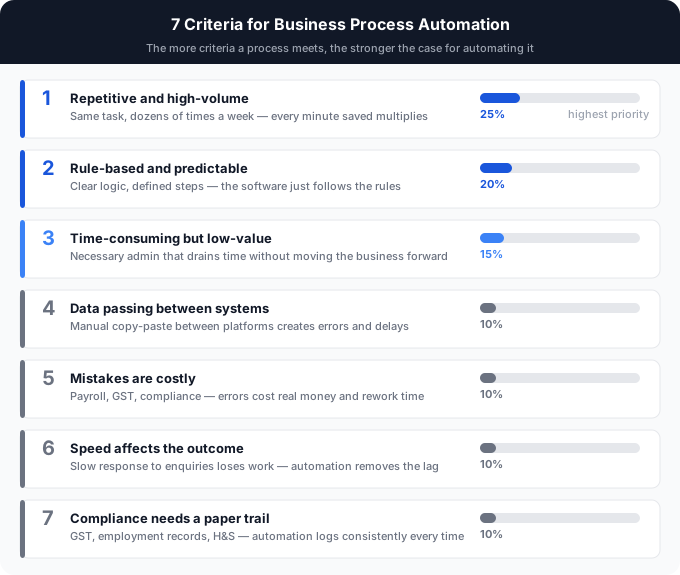
Seven characteristics separate good automation candidates from expensive distractions. The more of these a process has, the stronger the case for acting on it.
1. It happens repeatedly, at volume
Repetitive, high-volume tasks return the clearest ROI from automation, every minute saved per instance multiplies across every repetition
If your team is doing the same task dozens of times a week, the maths is simple: every minute saved per instance multiplies across every repetition. A task that takes 20 minutes and happens 50 times a month is over 16 hours. At $50 an hour, that’s $800 in staff time, every month, on one process.
For NZ small businesses, the most common examples are invoice reminders, appointment confirmations, lead follow-up emails, and routine data entry. These tasks follow a clear pattern. They’re predictable. And they eat time that could go somewhere more useful.
The key word is volume. A task that happens twice a month, even a painful one , probably isn’t worth the setup cost. A task that happens every day almost certainly is.
2. The rules are clear and consistent
Rule-based processes with predictable outcomes are the most reliable candidates for automation, the software doesn’t need to think, it just needs to follow the rules.
Workflow automation works well when a process follows consistent logic: if X happens, do Y. Sending a payment reminder three days before an invoice is due. Confirming an appointment 24 hours in advance. Moving a new enquiry into your CRM when someone fills in a contact form.
These processes have defined inputs, defined steps, and defined outputs. The software doesn’t need to think. It just needs to follow the rules reliably.
The test: can you write down every step in this process without leaving anything to interpretation? If yes, it’s likely automatable. If the honest answer is “it depends on the situation” or “experienced staff use their judgement here” – that’s a signal the process isn’t ready yet, or that only part of it should be automated.
Automating an ambiguous process doesn’t remove the ambiguity. It just makes it faster and harder to catch when something goes wrong.
3. It takes time but doesn’t create much value
Tasks that consume staff time without directly contributing to revenue or client relationships are among the highest-ROI targets for automation precisely because they happen constantly and require almost no judgement.
Some tasks have to happen but don’t directly contribute to revenue, client relationships, or anything that moves the business forward. Sorting and routing emails. Scheduling meetings. Copying information from one system into another. Chasing overdue invoices for the third time this week.
These are the tasks people describe as “just admin.” They’re not wrong to do them, but they’re not why you hired your team, and they’re not where your team does their best work.
The businesses seeing the clearest automation ROI are the ones automating the most boring-sounding tasks first: invoice reminders, appointment confirmations, lead follow-ups. These have the shortest payback periods precisely because they happen constantly and require almost no judgement. Freeing people from this kind of work is easy to justify. The value of their time applied elsewhere is usually obvious.
4. It involves passing data between systems
Manual data transfer between platforms is one of the most underestimated sources of operational friction in small businesses and one of the most straightforward to eliminate.
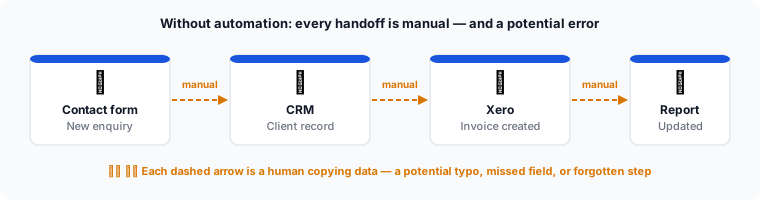
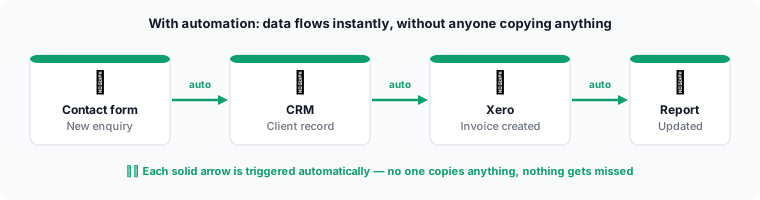
This is one of the most underestimated sources of friction in small business operations. When a task requires someone to copy information from one platform into another, like: a new client from your contact form into your CRM, a confirmed booking into your invoicing system, a completed job into your reporting spreadsheet, you’ve created two problems: time, and error.
Every manual handoff is a point where something can go wrong. The wrong row. A typo. A field that got missed. And when data lives in multiple places with humans as the bridge, inconsistencies accumulate quietly until something breaks visibly.
Tools like Zapier and Make exist specifically to handle these handoffs automatically, connecting the apps your business already uses without requiring any coding. If your current process involves anyone regularly copying and pasting between platforms, that’s one of the clearest signals that workflow automation would deliver immediate value.
5. Mistakes are costly
Processes where errors carry real financial, legal, or reputational consequences have a higher automation ROI than the time saved alone suggests, because the cost of a single mistake often exceeds months of setup cost.
Some processes are low-stakes if they go wrong – annoying, but fixable without much consequence. Others aren’t.
Payroll. GST filings. Compliance documentation. Order fulfilment. In these processes, errors cost real money, real time in rework, or real risk from getting it wrong with Inland Revenue or a client.
The hidden cost of manual error-prone processes is usually higher than it appears on any report. The cost of a mistake is spread across the people who notice it, the people who fix it, and whatever downstream effect it had before it was caught. For NZ small businesses without dedicated admin teams, that often means the business owner absorbs the rework personally.
Automation doesn’t eliminate all errors, but it eliminates the category that comes from people being tired, rushed, or working from information that’s no longer current.
6. Speed affects the outcome
Response speed directly affects whether you win or lose work and for processes where a human trigger causes the delay, automation converts that delay into a competitive advantage.
Some processes only matter if they’re fast. Quote generation. Responding to a new enquiry. Confirming a booking. Sending an onboarding email to a new client.
When a potential customer enquires and your team is busy, every hour of delay reduces your chance of winning the work. By the time follow-up happens on Thursday, the customer may have already gone with someone who responded on Monday.
Research from Harvard Business Review found that businesses responding to a new lead within one hour are nearly seven times more likely to have a meaningful conversation with a decision-maker than those that wait two hours and more than 60 times more likely than those that wait 24 hours. (Harvard Business Review, “The Short Life of Online Sales Leads”, 2011)
If the delay is caused by a manual step – someone has to notice the enquiry, draft a response, remember to follow up – that’s automatable. The speed improvement isn’t just operational. It directly affects whether you win or lose work.
7. Compliance requires a consistent paper trail
Anywhere a reliable audit trail is required (GST returns, employment records, health and safety documentation) automation produces consistency that manual processes structurally cannot.
Manual processes introduce variation. Automated ones don’t. For small NZ businesses that handle their own compliance, automation creates the documentation systematically: every step logged, every record consistent, every reminder triggered on time. When a question comes up from Inland Revenue or a client, the answer is already there.
Signs that a process is ready to automate now
Beyond the criteria above, a few operational signals point to processes that are already costing enough to justify acting on sooner rather than later.
- Consistent bottlenecks in the same place. If work regularly piles up at a specific point, for example: quotes waiting to go out, invoices not sent until end of week, follow-ups that only happen when someone remembers, that’s usually a manual step that could be replaced.
- Tasks that only happen when someone remembers. If a process depends on a person noticing, remembering, and prioritising a routine task, it’s vulnerable. The task gets done when things are calm and skipped when they’re not. Automation does it every time regardless of what else is happening.
- High staff time on low-value work. Calculate the actual cost: how often does this task happen, how long does it take, and what’s that worth in staff time? Even at NZ$50 per hour, a 30-minute weekly task costs over $1,300 a year on one process. Apply that across five similar tasks and the number becomes harder to ignore.
- Growth plans that manual processes can’t support. If scaling the business would require hiring people not to do new things, but just to keep up with the same things at higher volume — that’s a strong signal. The question is whether headcount growth is driven by value creation or by process replication.
- Frequent corrections and rework. Track where mistakes happen most. If the same types of errors recur in the same process, the solution is rarely “be more careful.” It’s redesign and often automation.
- Customer wait times tied to internal steps. If customers are waiting because a human has to manually trigger a step, check a system, or send an update, that delay is visible to them even when the cause is invisible. Slow response times are one of the most common reasons NZ small businesses lose work to faster competitors.
NZ Government Support for Automation
If budget is your constraint, the New Zealand government offers co-funding for small businesses investing in automation tools and processes. The automation co-funding pilot provides up to NZ$15,000 per business, running until June 2026. This can cover software subscriptions (Zapier, Make), custom integrations, or professional automation setup. Check beehive.govt.nz for eligibility and application details — the funding moves quickly.
Frequently asked questions
Where should we start if we’ve never automated anything?
Start with the process your team complains about most. Not the one that looks most impressive or the one with the biggest theoretical ROI — the one people actively dread. The tasks described as a “necessary evil.” The ones that come up in every team conversation.
These are almost always repetitive, rule-based, and high-volume enough to justify the effort. The first automation project should deliver a visible win quickly. That builds confidence and creates a template for what comes next. Invoice reminders and appointment confirmations are common first wins for NZ small businesses — unglamorous, but immediately impactful.
Do we need a specialist or can we set it up ourselves?
It depends on the complexity. Simple automations like connecting two tools, routing information, triggering a notification , can often be set up without specialist help using platforms like Zapier or Make. If you’re already using Xero, its built-in automation for invoice reminders and recurring invoices is free and worth using before looking anywhere else.
More complex automations involving multiple systems, custom logic, or significant data transformation generally benefit from someone who’s done it before. The risk of DIY-ing complex automation isn’t usually that it won’t work at launch — it’s that it breaks quietly later and no one notices until the damage is done.
What if the process isn’t fully consistent yet?
Standardise it first. Automating an inconsistent process embeds the inconsistency at speed. If the rules change depending on who’s doing it, or when, or why, that needs to be resolved before any automation enters the picture. The discipline of preparing a process for automation often improves it, even before a single tool is implemented.
How do we know if it worked?
Define the baseline before you start. How long does the process currently take? How often do errors occur? How much staff time does it consume per week? After implementation, measure the same things. The comparison is usually clear. Time saved is easy to count; the value of reduced errors and freed-up attention is often larger and harder to quantify, but still real.
What should we avoid automating?
Anything that requires genuine human judgement, relationship management, or contextual interpretation. Client conversations. Complex problem-solving. Situations where the right answer depends on reading a person or a circumstance. Automation is good at rules. It’s poor at nuance. The more a process depends on responding appropriately to something unpredictable, the less suitable it is and the more damage a poorly configured automation can do to a client relationship.
How do we fund automation?
If budget is your constraint, the New Zealand government offers co-funding for small businesses investing in automation tools and processes. The automation co-funding pilot provides up to NZ$15,000 per business, running until June 2026. This can cover software subscriptions (Zapier, Make), custom integrations, or professional automation setup. Check beehive.govt.nz for eligibility and application details — the funding moves quickly.
Does Dear John NZ do business automation for small businesses in New Zealand?
Dear John NZ is a business automation provider based in Paraparaumu, Kapiti Coast, working with small businesses across New Zealand. Automations connect the tools already in use, no new software to learn.
The practical shortcut
If the criteria above feel like a lot to work through at once, here’s a simpler starting point.
Ask your team: what’s the worst part of the week? Not the hardest part — the most tedious, most repetitive, most draining. The work that happens because it has to, not because anyone finds it useful or meaningful.
Those tasks are your first candidates for business automation. They’re almost always the right fit: repetitive, rule-based, high enough volume to justify the effort. And fixing them delivers two returns at once — the operational efficiency, and the morale improvement that comes from people spending less time on work that doesn’t deserve their attention.
That’s a reasonable place to start. Not because it’s the most sophisticated approach, but because it works and it builds the foundation for everything that comes after.
Dear John helps New Zealand businesses diagnose and fix broken systems ; including the ones held together with copy-paste and good intentions. Get in touch if you’d like a conversation about where business process automation could actually make a difference for your business. For AI tools that support your automation, see what Dear John builds for NZ businesses.