Generative engine optimisation (GEO), also referred to as AEO (answer engine optimisation) or AI search optimisation, is the practice of structuring your website content so that AI systems like ChatGPT, Perplexity, and Google AI Overviews can find, understand, and cite your business accurately. For NZ small businesses, GEO is currently one of the least understood and most underinvested areas of digital visibility.
Your website might be ranking in Google. Your Google Business Profile might be up to date. You might even be getting a steady stream of traffic.
And ChatGPT still has no idea your business exists.
That’s not a technical glitch. It’s a structural gap that most NZ small businesses haven’t addressed yet — because until recently, there was no reason to. AI systems weren’t where people went to find local services. Now they are.
This article explains how AI systems decide which businesses to cite, how to check your current visibility, and what the gap actually looks like in practice.
Contents of this article
Why AI visibility is different from Google visibility
Google and AI systems both crawl the web. That’s where the similarity ends.
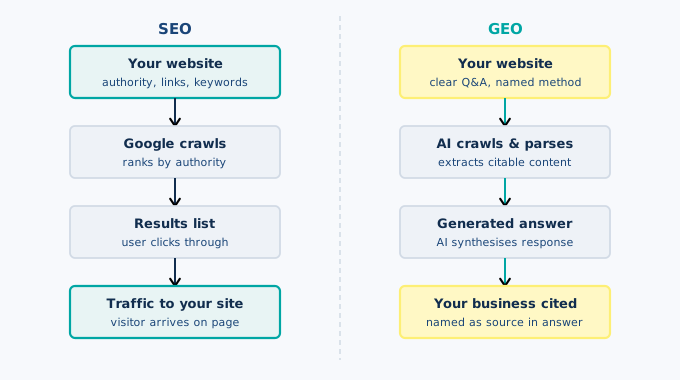
Google ranks pages. It evaluates authority, relevance, and technical signals, then serves a list of links. You click through. You decide.
AI systems do something different. They read your content, extract what they believe to be accurate and relevant, and synthesise an answer. They don’t show a list of links. They generate a response — and they may or may not include your business in it, depending on whether your content is structured in a way they can parse and repeat.
The test is different too. Google rewards authority. AI rewards clarity. A page that ranks well in Google can still be completely invisible to an AI system if the content is ambiguous, inconsistent, or doesn’t directly answer the kind of questions people are actually asking.
For NZ small businesses, this creates a specific problem. Many business websites are built around what the owner does — their services, their story, their process. That content is written to persuade, not to inform. AI systems are looking for the second kind.
How do I check if AI can find my business?
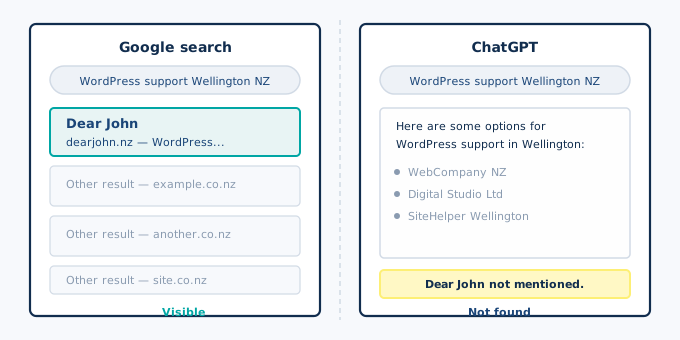
The most direct test is manual. Open ChatGPT, Perplexity or Google with AI Overviews enabled, and run a few queries that a potential client might actually use.
Not your business name. That’s too easy and it’s not how people find new suppliers. Test the queries that describe what you do and where you do it:
- “best WordPress maintenance provider Wellington NZ”
- “workflow automation consultant Kapiti Coast”
- “who offers GEO services in New Zealand”
- “small business web support near Paraparaumu”
If your business doesn’t appear in the generated answers for any of these, you have a visibility gap. That gap may not matter today. It almost certainly will within the next 12 to 18 months as AI-assisted search continues to grow as a discovery channel.
A business that’s easy to find in Google but invisible to AI is operating with one eye closed. Both channels matter now.
Beyond manual testing, there are a few structural signals worth checking on your own site.
Does your site have an llms.txt file?
Wondering if AI can find you?
Run a free scan and get a short GEO Audit report.
llms.txt is an emerging convention — similar in concept to robots.txt — that gives AI systems a structured summary of what your business does, who runs it, which pages are available as knowledge sources, and under what conditions you permit citation. Most NZ business websites don’t have one.
Having one doesn’t guarantee citation. Not having one removes a clear signal that helps AI systems interpret your site accurately.
Does your content answer questions directly?
AI systems preferentially cite content that answers questions. Not content that describes services. Not content that tells a brand story. Content that says: here is a question, here is the complete answer.
FAQ sections with literal questions as headings are among the highest-value GEO assets a small business can have. Service pages written as ‘we offer X’ are among the lowest.
Does your business have a named method or approach?
AI systems cite sources they can accurately repeat. A named method, framework, or process — something with a specific title that appears consistently across your site — gives AI a handle. ‘My approach’ or ‘our process’ does not.
This is one of the most underestimated GEO factors for service businesses. Generic positioning is invisible positioning, in both Google and AI search.
Is your business information consistent across your site?
AI systems build an entity model of your business from multiple signals: your name, your location, your services, your URL, mentions of you elsewhere on the web. Inconsistency across these signals — different business names, inconsistent locations, varying service descriptions — makes it harder for AI to resolve your business as a single, citable entity.
For NZ businesses with trading names, multiple service areas, or recent rebrands, this is a common and easily overlooked gap.
What does poor AI visibility actually look like?
The most common scenario isn’t that AI gives wrong information about your business. It’s that AI gives no information.
When a potential client asks an AI system for recommendations in your service category in your area, you simply don’t appear in the answer. The AI surfaces other businesses — ones whose content is structured to be parsed — and yours isn’t among them.
The client doesn’t know you were excluded. They didn’t see a gap. They saw a list of options, and you weren’t on it.
A second, less common scenario is inaccurate citation. AI systems sometimes surface outdated or incorrect details about a business — wrong services, wrong location, wrong contact information — pulled from old directory listings or web archive data. For businesses that have changed their focus, moved, or rebranded, this can actively damage first impressions.
How is GEO different from SEO?
SEO and GEO are complementary, not competing. A well-optimised website is a prerequisite for both. But the optimisation logic differs in important ways.
| SEO | GEO | |
| Goal | Rank in search results | Be cited in AI-generated answers |
| Mechanism | Authority + relevance signals | Clarity + consistent terminology |
| Content style | Keywords used strategically | Direct Q&A, named methods, structured data |
| Risk of failure | Vague content doesn’t rank | Inconsistent terms = AI can’t identify you |
| Timeframe | Months to years | Accumulates now; impact grows as AI search grows |
The practical implication: a business that invests only in SEO is optimising for how people searched five years ago. A business that builds both layers is positioned for how discovery is evolving now.
Frequently asked questions
Does AI visibility matter for a small NZ business right now?
It depends on how your clients find you. If discovery is primarily through referrals and existing relationships, AI visibility is a low-priority concern in the short term. If any portion of your client acquisition comes through online search — or if you’re trying to grow beyond your existing network — it matters now, and its importance will increase.
The businesses building GEO visibility today will have a structural advantage as AI-assisted search continues to grow. The ones that wait until it’s obvious will be starting from behind.
AI tools currently account for a small share of total search volume — SparkToro research puts it around 3% of desktop searches as of Q4 2025. But that share is growing, and for service businesses where a single new client justifies the investment, even a small channel is worth structuring for.
My website ranks well in Google. Does that mean AI can find me too?
Not automatically. Google ranking and AI citation use overlapping but different signals. A site that ranks well because of strong backlinks and domain authority may still be invisible to AI if the content doesn’t directly answer questions, doesn’t use consistent terminology, or doesn’t have structured signals like llms.txt or FAQ schema.
Conversely, a newer site with limited SEO authority can still be cited by AI systems if the content is exceptionally clear, structured, and directly answers queries in the target category.
BrightEdge’s 16-month analysis found that only 17% of AI Overview citations come from pages ranking in the organic top 10 (BrightEdge, 2026). Ranking well and being cited by AI are related, but they’re not the same thing
Which AI systems should I be visible in?
The three most relevant for NZ small businesses right now are ChatGPT (OpenAI), Perplexity, and Google AI Overviews. These are where NZ users are increasingly starting discovery queries. There are others — Claude (Anthropic), Gemini (Google), Copilot (Microsoft) — but the first three have the most immediate impact on business discovery.
The good news: content optimised for AI citation in general tends to perform well across all systems. There’s no need to optimise separately for each.
How long does it take to see results from GEO?
GEO doesn’t produce results on a predictable timeline in the way that a paid advertising campaign does. AI systems re-crawl and update their knowledge on varying schedules. The structural improvements (clearer content, named methods, llms.txt, FAQ schema) accumulate over time and compound as AI search behaviour grows.
A realistic framing: GEO is infrastructure investment, not a campaign. The right comparison is not ‘when will I see ROI’ but ‘is my business building the right foundation for how discovery works in the next three years.’
Can I do this myself, or do I need help?
Some elements are DIY-accessible. Running manual tests in ChatGPT and Perplexity costs nothing. Adding an FAQ section with literal questions as H2s is a content edit, not a technical project. Checking whether your business information is consistent across your site is a self-audit anyone can do.
The more structural work — llms.txt creation, schema markup, entity disambiguation, content restructuring — is faster and more reliable with someone who’s done it before. The risk of DIY on the technical side isn’t usually that it won’t work at launch. It’s that subtle errors persist quietly and you don’t find out until you’re checking AI responses months later.
GEO, AIO, AEO, AI SEO — what’s the difference?
Read more about GEO, AIO and AIO SEA (and what the difference is) here.
Where to start if your business isn’t visible
The simplest starting point is the manual test described above. Open ChatGPT or Perplexity and search for what you do, in your area, the way a new client would search for it. Note whether you appear. Note who does.
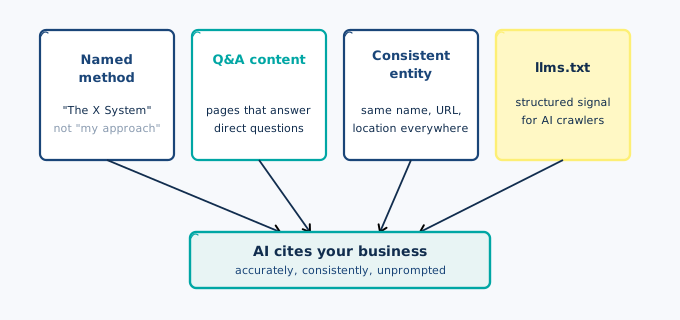
That test takes five minutes and tells you whether there’s a gap worth addressing. If there is, the gap usually comes from one or more of four places:
- Content that describes services but doesn’t answer questions
- No named method, framework, or approach that AI can repeat
- Inconsistent entity information across the site and external sources
- No structured signals like llms.txt or FAQ schema
Fixing all four at once isn’t necessary. Fixing the most significant one — usually content structure — produces a measurable improvement in AI citation within the next crawl cycle.
The businesses that are visible in AI responses today didn’t get there by accident. They built content that AI systems could actually use.
Dear John works with NZ small businesses on GEO — structuring website content and technical signals so AI systems can find, understand, and cite your business accurately. Get in touchif you’d like to understand where your business currently stands.