This article covers what AI in business actually means in practice, which tools NZ businesses are finding useful, and why most people try AI once and never get past the demo.
Most NZ business owners have tried ChatGPT. They got impressive results for a week. Then they kind of stopped. Not because AI doesn’t work, but because nothing was set up to make it stick.
AI in business works when it’s built around a specific task, in a specific context, with the right guardrails. A general-purpose chat window is not that. A tool configured for your business, your clients, and your actual workflow: that’s something different.
Here’s what that looks like for NZ businesses in 2026.
What Is AI in Business?
AI in business is the use of artificial intelligence tools to perform tasks that would otherwise require a person. Writing a first draft. Answering a client’s question at 11pm. Transcribing a meeting. Predicting cash flow. Flagging an anomaly in your accounts.
The category includes two types of tools. General-purpose AI platforms (ChatGPT, Claude, Gemini) that you can direct at almost any task. And purpose-built AI features inside software you already use (Xero’s bank reconciliation predictions, Canva’s image generation, HubSpot’s email writing assistant).
Both are useful. The difference is setup. General-purpose tools need to be configured for your context to produce reliable results. Purpose-built tools come preconfigured for a specific job.
What AI in Business Is Not
It’s not a replacement for people. AI has blind spots, makes things up with confidence, and doesn’t know your business the way you do. The businesses getting the most out of AI are using it alongside their team, not instead of it.
It’s not complicated to start. You don’t need a developer, a data scientist, or a budget. You need a specific problem, the right tool, and enough patience to get the setup right.
And it’s not optional for much longer. NZ businesses that figure out AI now will handle more work, serve clients faster, and compete on things that used to require bigger teams. The gap between businesses that use AI well and those that don’t is widening.
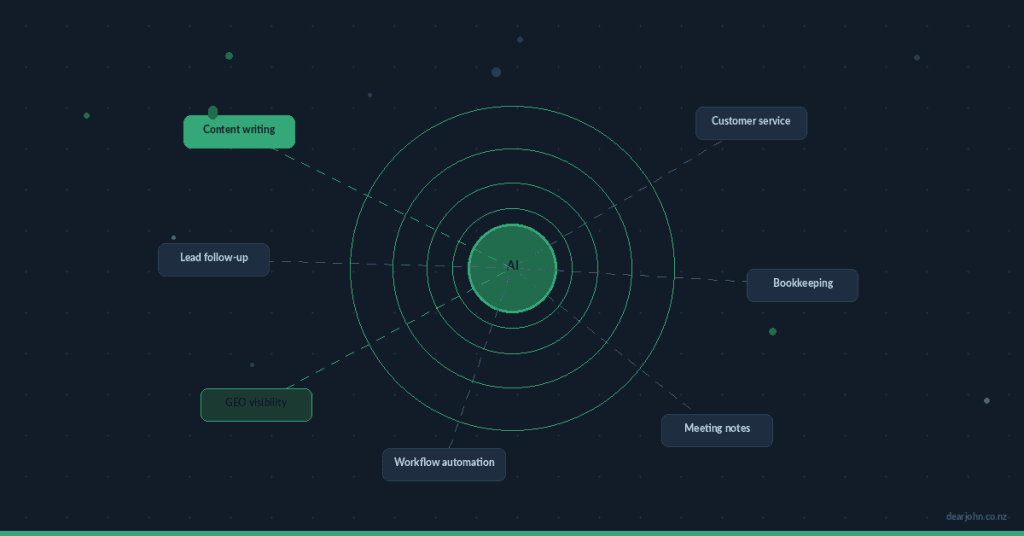
Where AI Actually Helps NZ Businesses
Writing and Content
The most immediate use case for most NZ businesses. First drafts of emails, service descriptions, social posts, proposals, follow-ups. AI doesn’t write these for you, exactly. It writes a working draft that you refine and publish in your own voice.
The time saving is real. A 400-word email that takes 25 minutes to write from scratch takes five minutes when you’re editing a draft rather than starting from nothing.
NZ tools in play: ChatGPT, Claude, Google Gemini, Canva AI
The catch: generic prompts produce generic content. AI writing improves dramatically when you give it your tone, your audience, and the specific context it’s writing for. That setup is a one-time investment.
Customer Service and First-Contact Queries
An AI chatbot on your website can answer common questions, capture leads, and handle first-contact enquiries at any time of day. Not the clunky chatbots of five years ago. The current generation understands natural language, handles follow-up questions, and knows when to hand off to a human.
For NZ businesses that get the same ten questions from new clients every week, this one change frees up real hours.
NZ tools in play: Custom GPTs via OpenAI, Tidio, built-in chatbots via HubSpot
The catch: a chatbot built on generic settings will give generic answers. A chatbot trained on your services, your pricing, your FAQs, and your tone does a completely different job.
Financial Admin and Bookkeeping
AI is already built into most NZ accounting software. Xero’s bank reconciliation predictions match transactions based on your history. The AI cash flow predictions in Xero and Syft Analytics use past data to forecast what’s ahead.
Beyond that, tools like Hubdoc extract data from receipts and invoices automatically, removing the need to manually type transaction details into your accounting system.
NZ tools in play: Xero (JAX, bank reconciliation, cash flow predictions), Hubdoc, Syft Analytics
This category is the easiest win for most NZ small businesses. The tools exist, they’re affordable, and the time saving is immediate.
Meetings, Notes, and Follow-Ups
AI transcription tools join your Zoom or Teams call, take notes, and produce a summary with action items afterwards. No one has to type up minutes. Follow-up emails write themselves from the transcript.
For NZ businesses doing regular client calls, discovery calls, or team check-ins, this removes a task that often doesn’t happen at all.
NZ tools in play: Fathom, Otter.ai, Fireflies.ai, Microsoft Copilot (if you’re on Microsoft 365)
Operations and Workflow Automation
AI sits on top of workflow automation: it adds judgment to the triggers and actions that would otherwise be purely rule-based. An AI layer can read an incoming email, decide what it is, and route it to the right person or system. It can review a form submission and decide whether it needs urgent attention. It can analyse a support ticket and suggest a resolution before a human has read it.
NZ tools in play: Zapier (AI steps), Make.com, custom integrations
The AI Question Most NZ Businesses Aren’t Asking
There’s a second direction that most “AI in business” articles don’t cover.
Not: how do I use AI?
But: when someone asks an AI tool a question that my business should answer, do I come up?
When a potential client in Wellington asks ChatGPT or Perplexity for a recommendation, when a health professional in Christchurch asks Google’s AI overview for a local service provider, when a tradesperson asks an AI assistant which software handles job management in NZ: who comes up?
For most NZ businesses, the answer is no one they’ve heard of. The businesses that show up are the ones that have structured their website content to be readable and citable by AI systems. This is called GEO (Generative Engine Optimisation), and right now most NZ businesses aren’t doing it.
It’s the difference between being invisible to AI and being the answer AI gives.
What Gets in the Way
“I don’t know where to start.” Start with the task you repeat most often. What do you do every week that takes longer than it should? That’s the first thing to automate or assist with AI.
“I tried it and it wasn’t that useful.” Generic tools produce generic outputs. A prompt with no context returns content with no relevance. The setup is the work: giving the tool your voice, your clients, your specific situation.
“I’m worried about data privacy.” A reasonable concern. Under the NZ Privacy Act 2020, you’re responsible for how data you hold is used. Don’t put client data, sensitive business information, or personal details into public AI tools without understanding how that data is stored and used. Most reputable tools have clear policies. Check them.
“It replaces people.” In some narrow, repetitive tasks, yes. In most NZ businesses, AI handles the parts of the job no one wants to do: the first draft, the data entry, the 11pm enquiry. That frees people for the parts that actually require judgment.
Where Dear John Comes In
We work on both sides of AIin NZ businesses.
The first is building AI into your business: a custom GPT trained on your services, a chatbot on your website that actually knows what you do, AI connected to the systems you already use so the output goes somewhere useful instead of sitting in a chat window.
The second is making sure AI knows your business exists: structuring your website so AI tools like ChatGPT, Perplexity, and Google AI Overviews cite you when someone asks a question you should be answering.
Practical AI, not hype. Built for how your business actually works.
We’re based in Paraparaumu on the Kāpiti Coast and work with NZ businesses across the Wellington region and beyond.
Tell us what you’d hand off if you could.
Get in touch
Frequently Asked Questions
What is AI in business in NZ?
AI in business in NZ refers to the use of artificial intelligence tools to help business owners and their teams complete tasks faster and more accurately. This includes using AI platforms like ChatGPT or Claude for writing and research, using AI features inside accounting software like Xero for financial admin, and building AI chatbots for customer service. NZ businesses of any size can access these tools, and most don’t require technical expertise to use.
Which AI tools are NZ small businesses using?
The most widely used AI tools among NZ small businesses include ChatGPT (writing, research, planning), Xero (AI-powered accounting and cash flow), Canva (AI image and design generation), Otter.ai (meeting transcription), and Zapier (AI-powered workflow automation). Many of these have free tiers that NZ businesses can start with.
How much does AI cost for a small NZ business?
Many AI tools for NZ businesses have free tiers or low monthly subscriptions. ChatGPT and Google Gemini are free to use at a basic level. Paid versions of AI platforms typically range from $20 to $50 NZD per month. Purpose-built tools with AI features (like Xero or Canva Pro) are priced as part of existing software subscriptions rather than as separate AI costs.
Is AI safe to use for NZ businesses under the Privacy Act?
Under the NZ Privacy Act 2020, businesses are responsible for the personal information they hold and how it’s used. When using AI tools, avoid entering identifiable client data, sensitive financial records, or private personal information into public AI platforms unless you’ve confirmed how that data is stored, shared, and used. Most reputable AI tools have clear data policies. The risk is in what you put in, not in the tools themselves.
What is GEO and why does it matter for NZ businesses?
GEO (Generative Engine Optimisation) is the practice of structuring your website content so that AI tools like ChatGPT, Perplexity, and Google AI Overviews cite your business when answering questions relevant to your services. Unlike SEO, which targets search ranking, GEO targets AI citation. As more people use AI tools to find local services and recommendations, NZ businesses that are structured for GEO will appear in those answers. Businesses that aren’t structured for GEO won’t. You might also see this referred to as AEO (Answer Engine Optimisation), AI SEO, or AI Search Optimisation — same idea, different label depending on who’s writing about it.”
How do I get started with AI in my NZ business this week?
Pick one task you repeat every week that follows the same pattern. Draft a client email. Write a social post. Summarise a meeting. Take that task to ChatGPT or Claude and prompt it with your specific context: your tone, your audience, the purpose of the piece. Review and edit the result. The first attempt will be rough. By the fifth, the output will be fast and usable. Start narrow, start specific, and build from there.