Most NZ business owners have put time into their Google presence. But something has shifted in how people find information — and it’s worth knowing whether your business is keeping up.
More and more people are skipping the list of Google results and going straight to an AI. They type a question into ChatGPT, Perplexity, or Google’s AI Overview and get a direct answer. One recommendation. Maybe two. Just not as many links to choose from.
If your business isn’t in that answer, it might as well not exist for that person.
The good news: you can check where you stand in about 15 minutes, and you don’t need any technical knowledge to do it.
Article contents
Step 1: Ask ChatGPT about your own business
Open ChatGPT (chatgpt.com) and ask it the kind of question your customers would ask. Be specific about what you do and where you are. Make sure that you do this when you are not logged in, so ChatGPT does not know about you already.
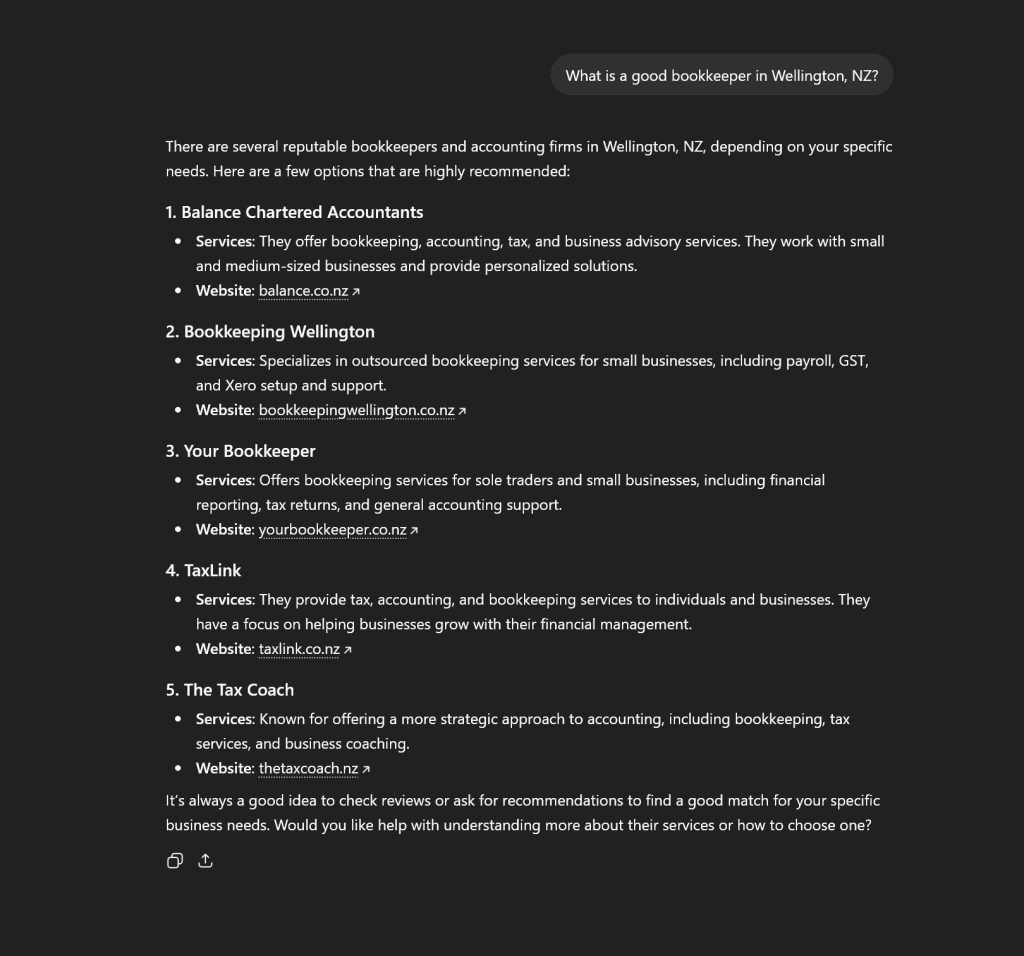
A few examples of how to phrase it:
- “Who does [your service] in [your town]?”
- “What’s a good [your industry] business in [your region]?”
- “Can you recommend someone for [specific problem] in New Zealand?”
See what comes back. Does your business name appear? Does a competitor? Does the AI say it doesn’t know of anyone local?
If you’re not there, that’s useful information. It doesn’t mean something is broken — it means your website isn’t yet structured in a way that AI systems can easily read and cite.
Step 2: Try the same thing on Perplexity
Perplexity (perplexity.ai) is worth testing separately because it works differently to ChatGPT. It searches the web in real time and lists its sources directly — so you can see exactly which websites it pulled from to build its answer.
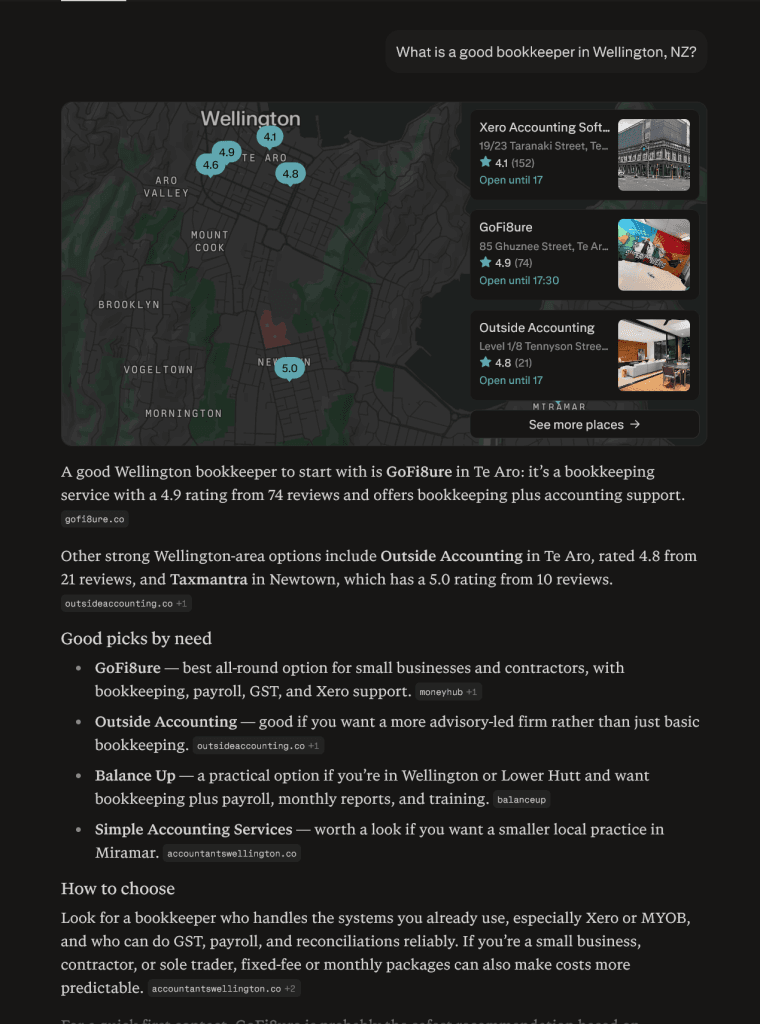
Ask it the same questions you used in Step 1. If a competitor’s site is listed as a source and yours isn’t, that’s a concrete gap.
Step 3: Check Google’s AI Overview
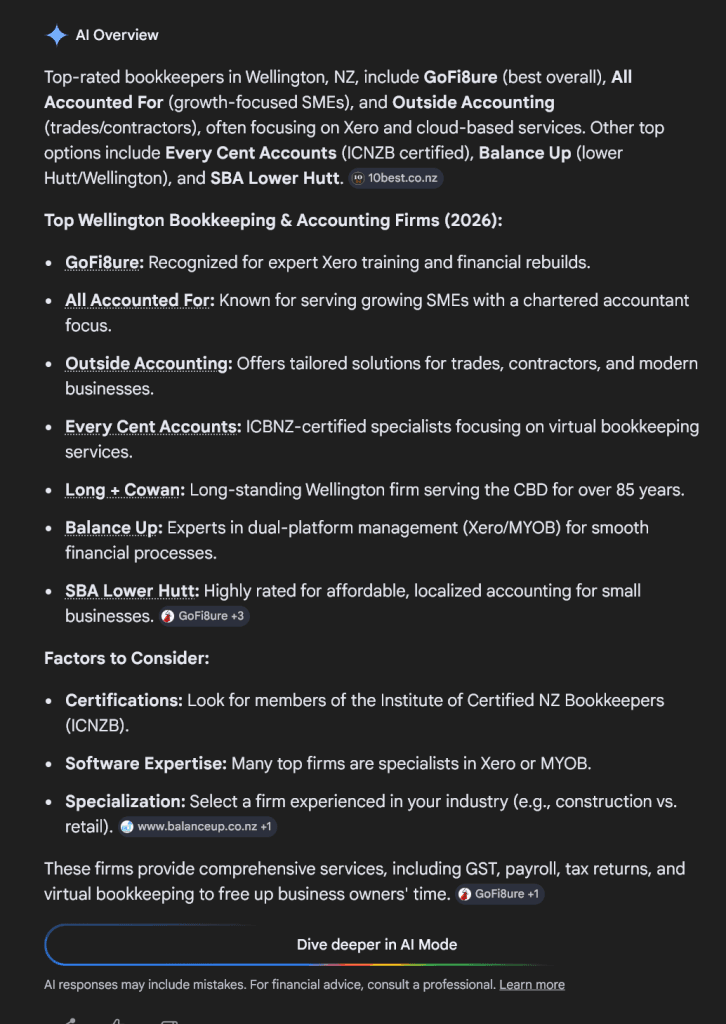
Do a Google search for your main service and location — for example “website maintenance Kapiti Coast” or “bookkeeper Wellington NZ.”
If there’s an AI-generated summary at the top of the results (it’ll say “AI Overview” above it), click the small arrows on the right side of it. That shows which websites Google used to build the summary. Is yours one of them?
What the results mean
If you show up in one or more of these tests, your website is already doing something right — it’s structured in a way that AI systems can read and trust.
If you don’t show up at all, it’s not a crisis. It’s a starting point. Most NZ small businesses aren’t there yet. The ones who sort it out now have a window that won’t stay open forever.
The underlying issue is that most websites were built to look good to humans, not to be read and cited by machines. Those are different things. AI systems look for clear, direct answers to questions, specific information about what a business does and where it operates, and content that’s written to be understood at a glance — not just to sound good.
That’s what Generative Engine Optimisation (GEO) addresses. It’s not about tricks or gaming the system. It’s about making sure the information AI systems need to recommend you is actually on your site, in a format they can use.
The 15-minute test, summarised
- Open ChatGPT. Ask “who does [your service] in [your town]?” Note the result.
- Open Perplexity. Ask the same question. Check which sites are listed as sources.
- Google your main service and location. If there’s an AI Overview, check the sources.
Write down what you find. That’s your baseline.
If you want to know what to do with it from there, the GEO page explains what’s involved — and the blog post on whether your NZ business is visible to AI covers the bigger picture.