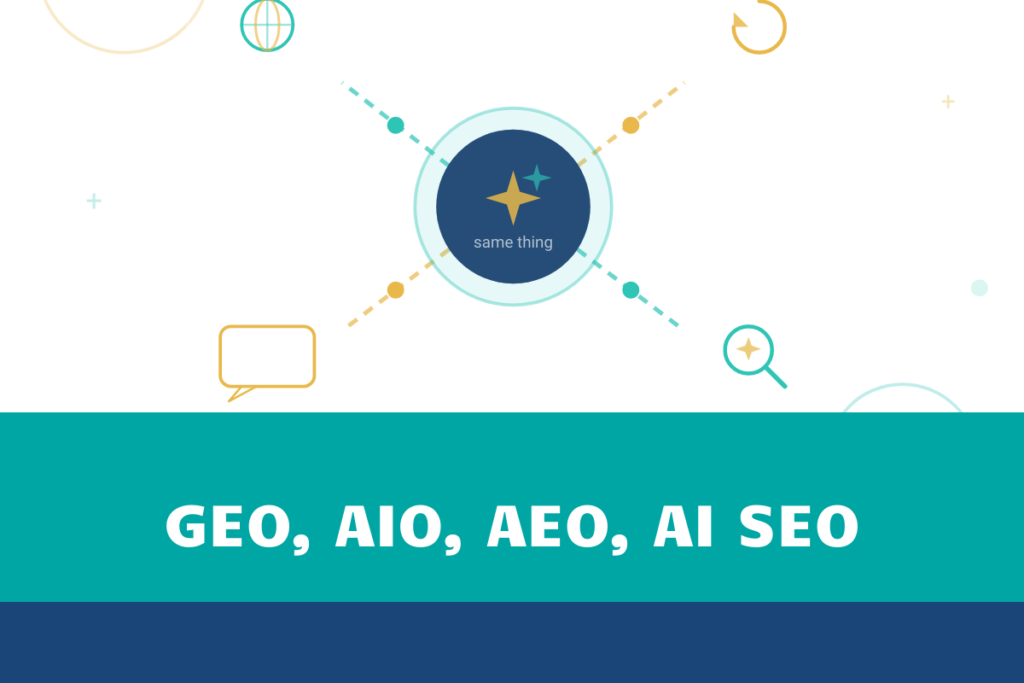
If you have started reading about AI and search, you have probably hit the same wall: four acronyms, used by different people, sometimes in the same sentence. GEO, AIO, AEO, AI SEO.
None of them are wrong. The terminology has not landed yet, because the underlying change is still new.
This article puts the four labels next to each other in plain English. By the end you will know which term points at which work, who tends to use each one in New Zealand, and which one matters for your business.
Why four terms exist for one shift
A few years ago, a Google search returned ten blue links. You clicked one or three, you decided.
That is changing. Now when someone asks ChatGPT, Perplexity, Google AI Overviews, or Microsoft Copilot a question, they get a single answer with a handful of sources cited. Not a list to choose from. One response, a few mentions.
If your business is not one of those mentions, you do not exist for that person in that moment.
Different parts of the industry noticed this shift at roughly the same time. They reached for different labels. Four of those labels stuck, and we are still sorting out which one wins. Probably none of them, in the long run. The underlying work is the same.
The four acronyms at a glance
| Acronym | Stands for | Focus | Where it shows up | Most common NZ usage |
|---|---|---|---|---|
| GEO | Generative Engine Optimisation | Being cited in AI-generated answers | ChatGPT, Perplexity, Claude, Gemini, AI Overviews | Gaining traction, international term, used by specialists |
| AIO | AI Optimisation | Same target as GEO, broader umbrella | All AI search systems | Used by NZ and Australian agencies who prefer shorter terms |
| AEO | Answer Engine Optimisation | Being cited in direct AI answers specifically | Featured-answer moments inside AI tools and voice assistants | Older term, predates LLMs, now overlaps heavily with GEO |
| AI SEO | AI Search Optimisation (or SEO with AI tools) | Two meanings depending on speaker | Google search results plus AI Overviews, or AI engines generally | Mixed usage, often unclear which meaning is intended |
The split is in framing, not in fundamentals. All four care about structured content, entity signals, schema markup, and clear answers to specific questions.
GEO: Generative Engine Optimisation
GEO is the term most international writers reach for. It refers to optimising your online presence specifically for AI engines that generate an answer rather than return a list.
The goal of GEO is to be cited, named, or recommended inside those AI-generated answers. That requires different content and different site structure than traditional SEO. Schema markup, llms.txt, entity consistency across Wikidata and Google Business Profile, content written for citation rather than ranking.
GEO does not replace SEO. It sits alongside it. Some of the work overlaps. The measurement is different: are AI systems citing you, not are you ranking.
Dear John NZ offers GEO as a service for NZ small business.
AIO: AI Optimisation
AIO means the same thing as GEO, more or less. A few NZ and Australian agencies prefer it because Generative Engine Optimisation is a mouthful and AIO fits a service-page heading. Practically, if a supplier in New Zealand says AIO, you can assume they mean GEO unless they tell you otherwise.
The slight risk with AIO is that some agencies use it to describe AI inside their internal workflows rather than AI search visibility for your business. If you hear AIO in a sales conversation, ask what they actually optimise for. Their answer tells you which version of AIO they sell.
AEO: Answer Engine Optimisation
AEO is the oldest of the four. It existed before LLMs were the default, when “answer engines” meant Google’s featured snippets and voice assistants like Alexa or Google Assistant.
The original AEO work focused on writing content that voice and search engines could quote directly. Question phrased clearly, answer in the first paragraph, structured data wrapping the whole thing.
Today AEO overlaps with GEO almost completely. The mechanics are the same: structure content so an AI system can extract a clean, confident answer with your business named as the source. Some practitioners still use AEO for the narrower “answer moment” framing. Others have rolled it into GEO.
For a NZ small business owner, the practical answer is: if a supplier offers AEO, they are doing GEO-adjacent work. Check what engines they target.
AI SEO: two meanings, both common
AI SEO is the term that causes the most confusion, because it points at two different things depending on who uses it.
Meaning one: traditional SEO with AI tools bolted on. The agency uses AI to write content briefs, generate keyword clusters, audit schema, speed up the work. The target stays Google. The metrics stay rankings, traffic, CTR. This is the older usage.
Meaning two: optimisation for AI-powered search specifically. Essentially the same as GEO, AIO, or AEO. This is the newer usage, and it is what most NZ agencies mean when they offer AI SEO in 2026.
If a supplier offers AI SEO, the first question is simple: do you mean SEO done with AI tools, or visibility in AI engines? The answer changes what you are buying.
More on the difference between AI SEO and GEO.
Which term is winning in New Zealand?
None of them, yet. Different agencies have made different bets. Dear John NZ uses GEO and AI SEO together as a hybrid label, because most NZ small business owners search for both terms.
A practical read of the market in mid 2026:
- GEO is the term international tools and specialist agencies use.
- AI SEO is the term most NZ general SEO agencies use as they extend into AI work.
- AIO appears more often in NZ and Australian agency materials, less so in international content.
- AEO is fading as a standalone label and being absorbed into GEO.
For practical NZ business decisions, the label matters less than the work. Ask what engines a supplier optimises for, what they measure, and whether they can show a citation result.
Does your NZ business need to care now?
More than half of New Zealanders use AI tools to research products and services in 2026. That figure is rising. Most NZ small businesses have not done anything about it yet.
The question worth asking is what someone in your customer base actually types when they need what you offer. A Wellington plumber gets searched for as “reliable plumber Kapiti Coast” inside ChatGPT. A Christchurch accountant gets searched for as “small business accountant Christchurch” inside Perplexity. A NZ business automation provider gets searched for as “who in New Zealand automates admin workflows” inside Claude.
If your business does not appear in those answers, the conversation is over before you knew it started.
The businesses that establish AI credibility now, with structured content, schema markup, entity consistency, and llms.txt in place, will be the default recommendations when the question comes up. The ones that wait will be playing catch-up against businesses that built the foundation earlier.
Find out whether your NZ business shows up in AI search.
Where the labels are heading
These four acronyms will collapse into one. Give it eighteen months and most people will talk about “AI visibility” without specifying which engine. The work underneath stays the same. The label drama will settle.
What matters right now is whether the person doing this for your business understands that AI engines are their own layer, with their own signals, and their own way of deciding who gets named.
Dear John NZ works with NZ small business across the Wellington region on GEO and AI SEO together. The fundamentals do not change: entity foundations first, content structured for citation, schema and llms.txt current, monitoring quarterly. Get in touch if you want a plain English conversation about which label fits your situation.
Frequently asked questions about GEO, AIO, AEO, AI SEO
What is AEO and how is it different from GEO?
AEO stands for Answer Engine Optimisation. The term predates LLMs and originally focused on Google’s featured snippets and voice assistants. Today AEO overlaps almost completely with GEO. Both aim to get a business cited as the source of a direct answer. AEO sometimes signals a narrower focus on the specific answer moment, while GEO covers a broader range of AI-generated responses. For most NZ businesses, the practical work is the same.
What is AIO and is it the same as GEO?
AIO stands for AI Optimisation. In most NZ and Australian agency usage, AIO means the same thing as GEO: optimising for AI engines that generate answers. The slight risk is that some agencies use AIO to describe AI in their internal workflows rather than AI search visibility for clients. If a supplier offers AIO, ask which version they sell.
Which term should I use when talking to a NZ supplier?
Use whichever term they introduce, then ask what they actually optimise for. The labels are unsettled. What you want to verify is which engines they target, how they measure success, and whether they have produced a citation result for an existing client. Suppliers who can answer those questions clearly know what they are doing regardless of which acronym they use.
Will GEO, AIO, AEO and AI SEO still exist as separate terms in 2027?
Probably not. The terminology is converging on “AI visibility” or a single dominant label. GEO is currently the most likely winner in international usage. AI SEO is the most common NZ usage. The underlying practice will outlive whichever label dominates. What matters is getting the foundation in place now, not which acronym you put on the invoice.
Do I need to worry about all four, or just one?
One framework covers all four. The same work that gets you cited in ChatGPT also gets you cited in Perplexity and Google AI Overviews. Schema markup, entity consistency, content structured for citation, llms.txt. The four acronyms describe the same toolkit from different angles. Build the foundation and you are covered regardless of which engine your customers ask.